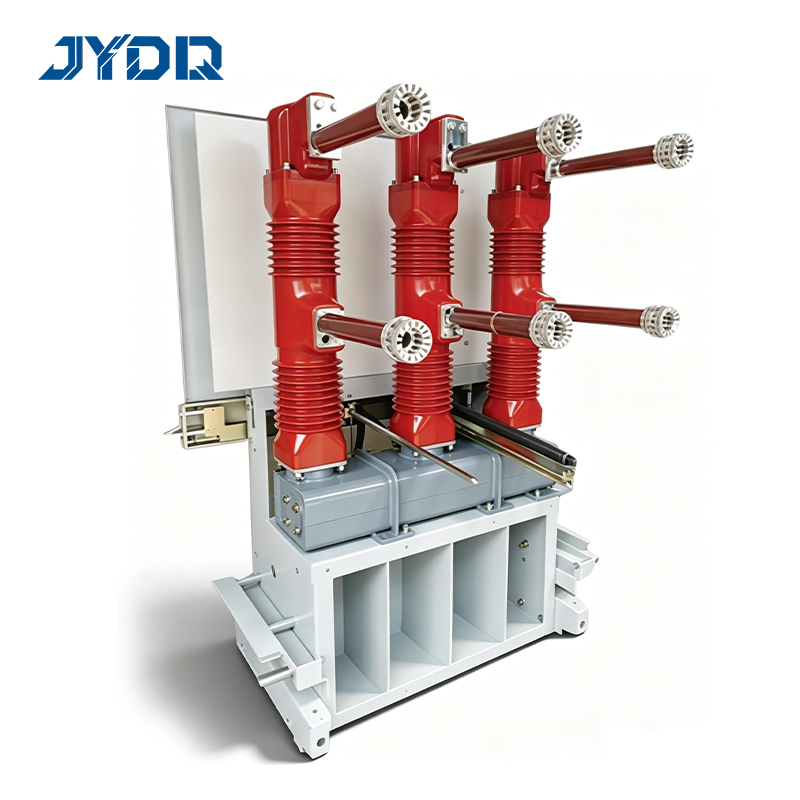
Indoor 40.5KV Series: Category Overview
Indoor 40.5KV Series circuit breakers serve as primary switching and fault protection devices at the upper boundary of the medium-voltage distribution range. Designed for installation within metal-enclosed switchgear panels—most commonly KYN61-40.5 withdrawable assemblies—these circuit breakers interrupt fault currents, isolate distribution network sections, and protect connected equipment under both normal switching operations and fault conditions.
At 40.5 kV, this voltage class bridges conventional switchgear 12kv installations and transmission voltage levels, covering utility distribution substations, large industrial power distribution centers, and grid-connected infrastructure where switching reliability and fault clearance speed are non-negotiable baseline requirements. For buyers evaluating Indoor 40.5KV Series equipment, the procurement decision involves more than rated specifications: compliance documentation, switchgear compatibility, and mechanism endurance class are the variables that typically separate adequate from unsuitable options.
Key Product Characteristics
The LW Series 40.5 kV indoor SF6 circuit breakers in this category are designed for withdrawable installation in KYN61-40.5 metal-enclosed switchgear. Core technical specifications include:
Rated voltage: 40.5 kV, serving 35–40.5 kV distribution systems
Rated breaking capacity: 25 kA and 31.5 kA options to match different installation fault levels
Mechanical life: 6,000 operations, providing extended service life for infrastructure applications
Self-developed SF6 operating mechanism built with premium materials for long, dependable service in substations and industrial grids
CE certified with 10-year warranty coverage
Customizable configurations available to meet project-specific requirements
The SF6 arc-quenching medium delivers reliable dielectric performance within the compact housing profile required for indoor panel installation. The spring-charged operating mechanism enables fast switching action consistent with IEC medium-voltage circuit breaker requirements for tripping response and contact endurance.
Before specifying Indoor 40.5KV Series circuit breakers for a given project, it is worth confirming which standards—the relevant IEC medium-voltage circuit breaker standard or applicable local grid codes—govern the installation. The applicable edition, test clauses, and market-specific requirements should be confirmed with the supplier and the relevant certification body before procurement begins.
Common Applications
Indoor 40.5KV Series circuit breakers are installed across a broad range of high-reliability infrastructure applications:
Utility distribution substations: receiving power from transmission networks and distributing to medium-voltage feeders, where fast fault isolation protects both upstream and downstream equipment
Large industrial power distribution centers: in petrochemical, mining, and heavy manufacturing facilities requiring reliable fault protection at the primary distribution level
Grid tied system connections: at the incoming feeder position within KYN61 switchgear assemblies for renewable energy and cogeneration projects, where reliable switching is essential during fault events and planned outages
Petrochemical and chemical plant substations: where indoor installation requirements and demanding reliability standards make SF6 technology well-suited for this voltage class
Power plant auxiliary distribution systems: where precise fault discrimination and coordination with upstream protection are critical to plant availability
For installations where earthing transformer working principle influences neutral earthing arrangements—such as impedance-earthed or resonant-earthed distribution systems—the withdrawable truck design of the KYN61 panel supports panel-level maintenance without requiring adjacent bay de-energization, simplifying scheduled maintenance in live operating substations.
How to Choose the Right Indoor 40.5KV Circuit Breaker
When evaluating options within the Indoor 40.5KV Series, the selection decision involves several interdependent variables. The following framework covers the dimensions that most often determine whether a circuit breaker is fit for a specific application.
Breaking Capacity: Confirm the prospective short-circuit current at the installation point from the network study. The available rated breaking capacities—25 kA and 31.5 kA—address the typical fault levels found in utility distribution and large industrial substations. Selecting breaking capacity based on the datasheet alone, without reference to the actual system fault level, is a common specification gap that creates either over-specification or inadequate fault protection.
Switchgear Panel Compatibility: The LW Series is designed for the KYN61-40.5 withdrawable switchgear standard. If the installation uses a different panel design—for example, 36kv air insulated switchgear configurations with different panel dimensions, truck withdrawal mechanisms, or secondary wiring connector standards—verify mechanical and electrical interchangeability before placing the order. Incompatibilities discovered after delivery typically create schedule and cost consequences that exceed the original specification effort.
Mechanism Endurance Class: IEC defines endurance classes for medium-voltage circuit breakers based on the required number of operating cycles over the equipment service life. Applications with infrequent manual switching operations have different endurance requirements than auto-reclosing or bus-tie applications with frequent switching cycles. Confirm the required class with the protection engineer before finalizing the specification.
Standards Compliance Basis: Comparing Indoor 40.5KV Series circuit breakers across suppliers on rated specifications is straightforward. The less visible evaluation is whether the supplier can provide complete IEC type-test documentation, factory acceptance test records, and the commissioning support the project requires. When a supplier references IEC compliance, the relevant follow-up questions are: which test clauses were completed, by which accredited laboratory, and whether the full report package is available for grid authority review.
If your project is extending from switchgear 12kv voltage levels to a 40.5 kV primary substation, be aware that compliance and documentation requirements at 40.5 kV are more extensive than those typically encountered at lower medium-voltage levels. Allow adequate time for type-test report review and grid authority pre-approval in the project schedule.
IEC Compliance vs. Local Grid Code: When Indoor 40.5KV Series circuit breakers must serve projects in markets where local grid codes diverge from the internationally adopted IEC standard, the question of which compliance basis takes precedence requires a project-by-project evaluation with the relevant grid authority. Both frameworks can be valid, but they are not always identical in test scope, insulation level requirements, or documentation format expectations.
Evaluation Checklist
Rated fault level confirmed from network short-circuit study
Breaking capacity matched to installation fault level (25 kA or 31.5 kA)
Switchgear panel type confirmed as KYN61-40.5 compatible
Mechanism endurance class requirement confirmed with protection engineer
Applicable standard basis (IEC or local grid code) identified and confirmed with grid authority
Type-test report availability and test laboratory accreditation confirmed with supplier
Factory acceptance test scope reviewed and agreed in purchase order
Why Indoor 40.5KV Equipment Matters for Infrastructure Buyers
Operational reliability at 40.5 kV is a non-negotiable baseline in utility and critical facility procurement. Equipment failure during a fault event at this voltage level can affect large sections of a distribution network, triggering cascading outages with significant financial and operational consequences for utilities and industrial operators.
Type test reports and routine test records are the primary quality assurance documentation in this procurement category. Buyers evaluating multiple suppliers in competitive tender processes often face inconsistent test documentation formats, varying test scope, and different certification bases that make direct technical comparison difficult. Establishing a consistent documentation checklist—covering type-test evidence, factory acceptance test records, and applicable certification marks—reduces evaluation friction and supports more reliable supplier qualification decisions.
For buyers sourcing Indoor 40.5KV Series equipment for export projects spanning multiple markets, standards requirements vary by destination. A product validated under the applicable IEC standard may satisfy requirements in European, Asian, and African markets, but may require supplemental documentation for grid authority approval in markets with specific local code interpretations or additional pre-qualification procedures.
Customization capability is a relevant differentiator when standard catalog configurations do not fully address application requirements. Specific terminal arrangements, secondary wiring configurations, environmental protection levels, or special operating mechanism settings may require non-standard production. Confirming customization scope, technical feasibility, and lead-time implications early in the procurement process prevents schedule disruption downstream. The LW Series offers customizable configurations to address project-specific requirements within the Indoor 40.5KV Series product range.

 EN